
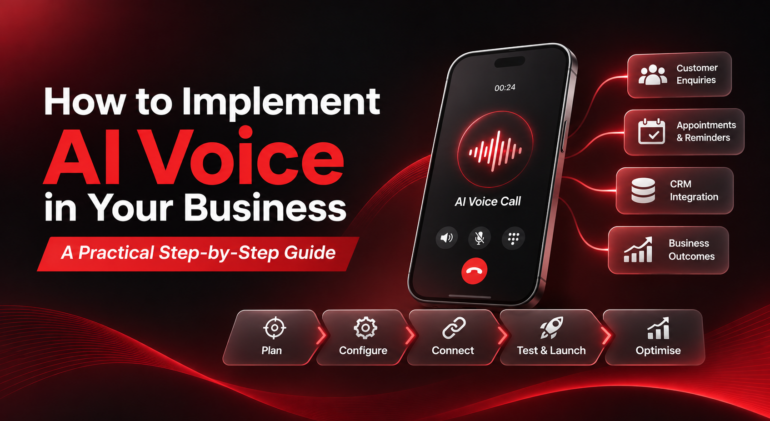
How to Implement AI Voice in Your Business – Practical Step-by-Step Guide

Executive Summary A successful AI Voice project should begin with a clear business problem, not with the technology or a long list of features. Businesses should start with one high-value and measurable use case before expanding automation across more departments or workflows. Call flows, knowledge sources, system integrations, human escalation rules, privacy requirements, and success metrics must be defined before the pilot goes live. Testing should reflect real customer behaviour, including accents, interruptions, background noise, mixed languages, incomplete answers, and requests to speak with a human. AI Voice is not a one-time installation. It requires monitoring, review, and continuous optimisation based on actual call outcomes and business results. Before You Start: AI Voice Is a Business Project, Not Just an IT Tool When I speak with businesses about AI Voice, the first question is usually about features. Can it answer calls? Can it speak multiple languages? Can it qualify leads? Can it update the CRM? All fair questions, but honestly, these are not the best starting point. The better first question is: what business problem are you trying to solve? Some companies are losing enquiries after office hours. Some have customer service teams spending most of the day answering the same questions. Others have thousands of leads, reminders, appointments, or payment follow-ups that their teams cannot complete consistently. These are very different problems, so the AI Voice setup also cannot be the same. My honest view is simple: do not implement AI Voice because it sounds impressive in a presentation. Implement it because there is a clear call-related problem, a measurable outcome, and a workflow that can be improved. Otherwise, the project may look good during the demo but become difficult to justify after launch. This guide explains the practical implementation process from a business development and solution-selling point of view. It is not only about what the technology can do. It is also about what the business must prepare before the technology can work properly. Unlike traditional interactive voice response systems that ask callers to press numbers through a fixed menu, AI Voice allows customers to perform a human-like conversation. The system listens, understands the caller’s intent, and responds based on the context of the conversation. This matters because customer communication is no longer limited to one direction. Customers call businesses for help, enquiries, bookings and support. At the same time, businesses also need to reach out to customers for lead follow-ups, payment reminders, appointment confirmations, surveys and campaign updates. For many businesses, the challenge is no longer just answering the phone. The challenge is managing every call opportunity properly, whether it is inbound or outbound. Step 1: Define the Business Problem Clearly Do not start with “we want AI.” Start with “we have this call problem.” This one sounds obvious, but many projects still skip it. The business problem should be specific enough that your team can measure whether the implementation has improved anything. Common examples include: Too many missed inbound calls during peak periods, lunch hours, weekends, or after office hours. Customer service agents spending too much time on repetitive enquiries. Slow sales follow-up causing warm leads to become cold. Inconsistent appointment reminders, payment reminders, surveys, or service updates. Long waiting time before callers reach the right department. Poor visibility because call outcomes are not recorded consistently. High call volume that cannot be handled without increasing headcount. At this stage, capture the current baseline. How many calls are received or made each day? How many are missed? How long do customers wait? How many leads are contacted? How many calls are completed successfully? Without a baseline, everyone may have a different opinion later on whether the AI Voice project is working. Also be honest about the problem. Sometimes the issue is not manpower. It may be outdated customer data, unclear ownership, a messy escalation process, or departments not agreeing on who should handle what. AI Voice can automate a process, but it cannot magically settle internal confusion. Step 2: Select One High-Value Use Case for the First Phase Many businesses want to automate everything at once: customer support, sales qualification, collections, appointments, surveys, and internal calls. From the sales side, I understand why. More use cases make the proposal look more exciting. From the implementation side, however, this is where projects start becoming too big, too slow, and very hard to measure. For the first phase, choose one use case that has: A clear and repetitive call flow. Enough call volume to create meaningful business value. A measurable outcome. Manageable operational and compliance risk. A defined owner inside the business. Information that can be prepared and maintained properly. Good pilot use cases may include answering frequently asked questions, appointment confirmation, first-level lead qualification, payment reminders, service status updates, or after-hours enquiry capture. Not every call need AI, and not every process should be automated on day one. Sensitive complaints, high-value negotiations, complex technical support, or conversations requiring judgement may still be better handled by a human. Google Cloud recommends building conversational agents iteratively, starting with the main requests before expanding into more complex conversation paths. This is a sensible approach for AI Voice too: start small, validate, then expand. Step 3: Map the Existing Call Journey Before designing the AI agent, map how the call is handled today. This is where the business team, operations team, customer service team, sales team, and technical team need to sit together. Do not assume everyone understands the workflow in the same way. For each call journey, document: What triggers the call. Who is calling and what information may already be available. The questions normally asked by the customer or agent. The information needed to complete the task. What system the information comes from. What action should happen during or after the call. Which outcomes count as successful. Which situations require transfer or escalation. Who owns the next action after the call ends. For example, an appointment reminder is not only “call the customer and remind them.” The actual flow
Read more
AI Voice

What is AI Voice and the Future of Customer Support

Executive Summary Businesses today face growing pressure to respond faster, manage more customer interactions, and maintain consistent service across every call. AI Voice helps businesses automate both inbound and outbound calls, from answering customer enquiries to qualifying leads, sending reminders, and supporting follow-up campaigns. Current business challenges such as missed calls, long waiting times, high manpower costs, slow follow-ups, and inconsistent customer experience can directly affect revenue, retention, and customer trust. AI Voice supports a hybrid customer engagement model where AI handles repetitive and high-volume call tasks while human teams focus on complex, sensitive, or high-value conversations. REDtone AI Voice enables Malaysian businesses to improve call handling, scale outbound campaigns, capture call insights, update CRM data, and deliver faster and more consistent customer engagement. What is AI Voice? AI Voice is an artificial intelligence-powered voice technology that allows businesses to automate phone conversations in a natural and human-like way. Instead of relying only on human agents to answer every call or manually conduct every outbound campaign, AI Voice can understand spoken language, respond to customer enquiries, qualify leads, route calls, send reminders, collect information, and support business workflows in real time. Unlike traditional interactive voice response systems that ask callers to press numbers through a fixed menu, AI Voice allows customers to perform a human-like conversation. The system listens, understands the caller’s intent, and responds based on the context of the conversation. This matters because customer communication is no longer limited to one direction. Customers call businesses for help, enquiries, bookings and support. At the same time, businesses also need to reach out to customers for lead follow-ups, payment reminders, appointment confirmations, surveys and campaign updates. For many businesses, the challenge is no longer just answering the phone. The challenge is managing every call opportunity properly, whether it is inbound or outbound. Current Challenges Faced by Businesses Many businesses still depend heavily on human teams to manage phone-based customer engagement. While human agents remain important, manual call handling can become difficult to scale when call volumes increase or when teams need to manage both incoming and outgoing calls at the same time. Common challenges include missed calls, long waiting times, high manpower costs, inconsistent customer experience, slow outbound follow-ups, limited after-hours support and poor visibility over call outcomes. These challenges can quietly affect business performance. A missed inbound call could mean a lost sales enquiry. A delayed outbound follow-up could cause a warm lead to go cold. A customer who waits too long may become frustrated. A finance team that depends on manual payment reminders may struggle to follow up consistently. A sales team that manually qualifies every lead may spend too much time on low-potential prospects. According to Zendesk, poor customer experience can cause customers to switch to competitors, especially when businesses fail to meet rising expectations for speed, convenience and support quality. For businesses, this means call handling is no longer just an operational issue. It is directly connected to customer trust, loyalty and revenue. This is where AI Voice becomes valuable. It helps businesses answer faster, follow up more consistently, reduce repetitive manual work, and turn every call into trackable business data. Why AI Voice Matters in Customer Support and Customer Engagement Customer expectations have changed. People want fast, clear and reliable responses, especially when they take the time to call a business directly. When a customer calls, there is usually a reason. They may need help urgently, want to ask about a product, confirm a booking, follow up on a request, or speak to someone before making a decision. If no one answers, the customer may move on before business even has a chance to respond. At the same time, businesses cannot depend only on inbound calls. Sales, marketing, finance, operations and service teams often need to reach out to customers proactively. This may include calling prospects, reminding customers about appointments, following up after events, collecting feedback, or sending payment reminders. AI Voice gives businesses a way to manage both sides of communication more efficiently. It can answer inbound calls instantly and support outbound calls at scale, while keeping the customer experience consistent. The goal is not to remove the human touch. The goal is to protect it. By allowing AI to handle repetitive, high-volume and structured conversations, human teams can focus on the calls that need empathy, judgement, negotiation and relationship-building. How AI Voice Works AI Voice combines several technologies to create a smooth voice conversation between customers and businesses. These technologies usually include speech recognition, natural language processing, conversational AI, text-to-speech, workflow automation and system integration. When a customer speaks, the AI Voice system listens, converts speech into text, understands the intent behind the request, and responds using a voice-based reply. Depending on the setup, the system can also perform actions such as checking information, logging call details, updating a CRM, sending a follow-up message, routing the call to a human agent, or triggering the next workflow. For inbound calls, AI Voice can understand what the caller needs and guide them to the right outcome. For outbound calls, AI Voice can call customers or prospects, ask structured questions, capture responses, identify interest levels, and update business systems automatically. Salesforce describes AI in customer service as a way to enhance customer interactions, streamline support processes, automate responses, analyse customer needs, and escalate complex issues to service representatives when necessary. A well-designed AI Voice solution can also be trained using company-specific information such as product manuals, FAQs, internal policies, service procedures and approved scripts. This helps the AI agent provide answers that are more accurate, consistent, and aligned with the company’s communication standards. Benefits of AI Voice for Inbound Calls 1. Better Lead Management and Prioritisation Not every lead has the same level of urgency or buying intent. Some leads are ready for a sales call, while others may need more nurturing before they become serious opportunities. AI CRM helps businesses prioritise leads more effectively through AI lead scoring, intelligent routing, and customer behaviour analysis.
Read more