
AI Voice in Payment Recovery: Achieving a 68% Customer Payment Rate Through Automated Outreach
Success Story | REDtone AI Voice
How a Malaysian funeral and memorial services provider explored AI-powered voice automation to improve customer payment follow-ups and support debt recovery operations.
- Industry:
- Funeral and Memorial Services
- Solution:
- REDtone AI Voice
- Application:
- Automated Outbound Calling and Payment Recovery
- Project Type:
- Proof of Concept (POC)
Executive Summary
Payment recovery remains one of the more demanding areas of customer engagement. Reaching customers takes time, unanswered calls require further attempts and each conversation needs to be followed up properly. For organisations managing ongoing payment commitments, this creates a considerable amount of repetitive work.
An established Malaysian funeral and memorial services provider recently explored REDtone AI Voice as part of a proof of concept (POC) focused on customer payment recovery.
The exercise examined how AI-powered outbound calls could support customer outreach and repeated contact attempts. It also provided an opportunity to evaluate the role of conversational AI in a business process where consistent follow-up and customer communication are particularly important.
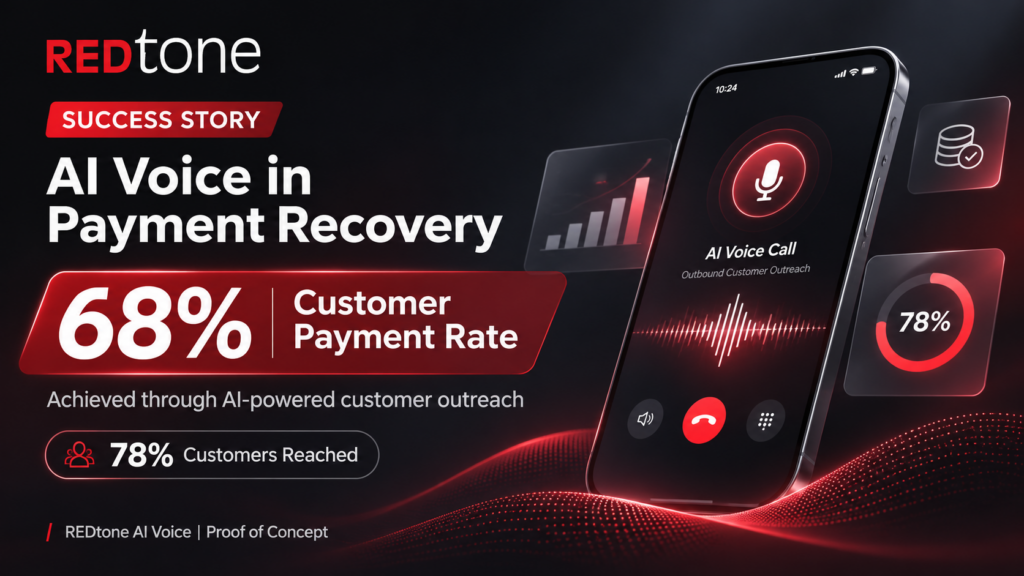
The reported results were encouraging. During the POC, 78% of customers answered at least one AI call, while 68% of the total customer group made payments. The payment rate exceeded the project's stated 50% target by approximately 18 percentage points.
POC Performance Highlights
- 78% Customer Reach Rate
- 68% Customer Payment Rate
- 50% Target Payment Rate
- +18 percentage points Performance Against Target
The findings provide an early indication of how AI Voice can support payment-related customer engagement. They also highlight the importance of having proper follow-up processes, reliable customer records and human oversight alongside automated calling.
1. The Business Context: Managing Customer Payments in a Sensitive Industry
Funeral and memorial services involve a different type of customer relationship from many conventional service industries.
Customers may be arranging services for family members, managing memorial plans or fulfilling existing financial commitments. Conversations involving payments require a professional and considerate approach. Clear information matters, and so does the way that information is communicated.
For service providers, payment collection is an ongoing operational responsibility. Customers may need reminders about upcoming payments, clarification on outstanding balances or assistance with payment-related enquiries.
Reaching them consistently can be challenging.
Some customers may not answer an unfamiliar number. Others may be unavailable during the initial call and require another attempt. Even after a successful conversation, additional follow-up may be needed before a payment is completed.
Each unsuccessful contact creates another task for the organisation. Staff need to revisit the customer record, check the previous communication and decide what action should follow.
Across a large customer base, these activities can consume considerable operational resources.
There is also the question of customer experience. Frequent or poorly coordinated calls can create frustration, especially when customers have already responded or made arrangements with the organisation.
A well-managed payment recovery process needs consistent communication, appropriate timing and accurate customer information. It also needs a way to track conversations and follow-up actions so that customers are contacted with the right information.
This is an area where AI-powered voice automation offers practical possibilities.
2. The Challenge: Maintaining Consistent Follow-Ups
One of the difficulties with outbound payment recovery is the amount of work involved in reaching the right person.
An unanswered call leaves the account unresolved. Another attempt may be necessary, sometimes more than once.
When managed manually, the process involves several activities:
- Identifying customers who require follow-up.
- Making outbound calls and recording the outcomes.
- Tracking customers who could not be reached.
- Scheduling subsequent contact attempts.
- Updating account information after successful conversations.
- Directing complex enquiries or sensitive situations to the appropriate personnel.
These tasks are straightforward individually. The workload becomes more demanding as the number of accounts and contact attempts grows.
Staff also need to maintain consistency across conversations. Customers should receive accurate information about their payment status and available next steps. Any follow-up should reflect what was discussed previously.
For an organisation in the funeral and memorial services industry, this consistency carries additional importance. Payment communication needs to be handled respectfully, with room for human attention where circumstances require it.
AI Voice presents an opportunity to automate selected parts of this process.
Routine outreach can be organised through a calling campaign, while customer responses help determine the next action. This gives businesses a more structured way to manage follow-ups and reduce the amount of manual calling involved.
The Malaysian service provider's POC provided a practical setting to evaluate this approach using real payment recovery outreach.
3. Exploring AI Voice Through a Proof of Concept
The POC focused on the use of AI-powered voice calls to contact customers regarding payment recovery.
The exercise involved actual outbound calling activity and tracked customer outcomes. This allowed the organisation to assess how the technology performed during a live outreach programme.
The reported calling activity included initial calls and subsequent recalls. This is an important part of the evaluation because customer outreach rarely succeeds through a single attempt.
A customer may be busy when the phone rings. They may miss the call entirely or need to be contacted at another time.
Repeated outreach creates additional opportunities to establish contact. It also highlights why calling activity needs to be tracked carefully. Without reliable records, teams may struggle to determine which customers have been reached and which accounts still need attention.
For this POC, the reported results covered customer contact and payment outcomes. These provided measurable indicators of how the outreach programme performed.
Three questions were particularly relevant to the assessment:
Could AI Voice help reach customers through outbound calling?
Customer reach is a fundamental requirement for payment recovery. An organisation needs to establish contact before it can communicate outstanding payment information or discuss further action.
Would repeated calling support the outreach process?
Unanswered calls are common in outbound campaigns. The POC included recall activity, providing a practical view of customer engagement across multiple contact attempts.
What payment outcomes would be recorded during the exercise?
The organisation could assess the percentage of customers who made payments during the reporting period and compare this with its stated target.
Together, these measures provide a useful starting point for assessing AI Voice in payment recovery operations.
4. The REDtone AI Voice Solution
REDtone AI Voice brings conversational AI together with enterprise voice infrastructure and business workflow automation.
The solution supports both inbound and outbound communications. Organisations can configure AI voice agents around specific business requirements, including customer enquiries, payment reminders, appointment confirmations and follow-up campaigns.
For payment recovery, several capabilities are particularly relevant.
4.1 Conversational AI for Customer Engagement
Traditional automated calling systems often rely on recorded messages or menu-based responses.
Conversational AI allows customers to interact with an AI agent through spoken language. The system can interpret what the caller says, maintain context during the conversation and provide responses based on its configured instructions and available information.
In a payment-related workflow, this may involve explaining the purpose of a call, presenting approved payment information or identifying whether a customer requires further assistance.
The conversation can also be configured to recognise situations that need special handling.
A customer who wants clarification on an account may need a different response from someone requesting a callback. Sensitive circumstances may require the conversation to be referred to an authorised employee.
These interactions can be configured around the organisation's policies and customer communication requirements.
4.2 Automated Outbound Calling and Recall Management
Outbound calling is a core capability of REDtone AI Voice.
Businesses can run calling campaigns using customer contact lists, with configurable calling capacity and scheduling.
For unanswered calls, the platform supports automatic retry functions and voicemail detection. This helps organisations manage repeated outreach without manually initiating every attempt.
The relevance to payment recovery is clear.
A missed call should remain visible in the process so the next action can be determined. Depending on the configured rules, the system may schedule another attempt or record that further attention is required.
The POC's initial calling and recall activity demonstrates why repeated contact attempts are an important part of this use case.
4.3 Payment Follow-Up Workflows
An effective payment recovery process also needs to account for what happens after a conversation.
REDtone AI Voice supports configurable workflows that can use call outcomes to determine subsequent actions.
For example, a payment-related workflow can be designed to:
- Record a customer's payment commitment.
- Capture a proposed payment date.
- Send an approved reminder or payment link through a connected channel.
- Schedule a follow-up based on the customer's response.
- Update a connected business system.
- Flag accounts that require human attention.
The exact sequence depends on the organisation's collection procedures and system integration requirements.
This is useful for teams managing numerous customer accounts, particularly where payment arrangements and follow-up dates need to be monitored over time.
4.4 Integration with Existing Enterprise Systems
Customer payment information is normally maintained across business applications. These may include CRM platforms, billing databases, payment systems or other internal records.
REDtone AI Voice supports integration through APIs and compatible enterprise systems.
Such connections allow voice interactions to become part of a wider business process.
For instance, an authorised system integration could retrieve relevant account information before a call, record the outcome afterwards and update the next required action.
Where supported by the connected applications, payment status can also be checked before another reminder is issued.
This helps teams work with the information already available in their business systems and reduces the need to manually transfer data between applications.
The actual integration requirements are assessed during solution design. The POC results discussed in this case study do not establish which integrations were implemented for this particular customer.
4.5 Call Analytics and Performance Monitoring
Outbound campaigns generate information that can help businesses understand how customers respond to different communication approaches.
REDtone AI Voice provides capabilities for call logging, recordings, transcripts, campaign reporting and voice analytics.
Depending on the deployment configuration, these records can help organisations examine contact outcomes, identify unsuccessful attempts and review conversations that require improvement.
For payment recovery operations, this information helps teams assess their calling strategies and identify areas requiring further attention.
It also gives operations personnel a clearer picture of what is happening throughout an outreach campaign.
4.6 Human Escalation for Sensitive Cases
Automated calling needs clearly defined boundaries.
Some customers may have complex payment arrangements, account disputes or personal circumstances that require individual attention.
REDtone AI Voice supports escalation workflows that allow selected interactions to be referred to human personnel.
This is especially relevant when handling financial matters in sensitive service industries.
Human teams remain responsible for decisions requiring judgement, discretion or authority beyond the AI agent's configured role.
With the appropriate setup, routine calls can be managed through AI Voice while employees focus on cases that require direct involvement.
5. POC Results: Customer Reach and Payment Outcomes
The POC reported positive customer engagement and payment outcomes.
78% of customers answered at least one AI call.
This indicates that the outbound calling exercise successfully established contact with a substantial proportion of the customer group.
Customer reach is an important operational measure because unanswered calls are a recurring challenge in payment recovery activities.
The presence of both initial calls and recalls in the reported activity also shows the relevance of sustained outreach.
Repeated attempts were part of the calling exercise. This provides useful context for the reach rate, although the available summary does not isolate how many customers were reached specifically through recalls.
68% of customers made payments during the reported POC period.
This was the strongest commercial result recorded in the exercise.
Against the stated target of 50%, the reported payment rate was approximately 18 percentage points higher.
For an organisation assessing AI Voice in payment recovery, this provides a meaningful outcome to examine alongside the contact rate.
The results suggest that automated voice outreach can play a useful role in payment recovery, particularly when customer contact and follow-up activities need to be managed consistently.
There are also some important considerations when interpreting the figures.
The reported payment rate measures the proportion of customers who paid. It does not establish the amount collected as a percentage of outstanding debt. The summary also does not provide a comparison against the organisation's previous manual collection performance.
These details matter when assessing the wider financial and operational impact.
The findings support the viability of the approach within this POC. A longer evaluation with additional operational measurements would help determine how well it performs across different customer groups and calling conditions.
6. Understanding the Business Value
The POC provides useful evidence about customer reach and payment outcomes.
It also highlights several areas worth considering for organisations reviewing their payment recovery operations.
More Structured Outbound Engagement
Payment reminders often involve repeating similar communication activities across a large customer base.
AI Voice allows businesses to configure how these activities are handled, including calling schedules, approved conversation flows and the recording of call outcomes.
This can help teams maintain a consistent approach throughout an outbound campaign.
Better Management of Repeated Contact Attempts
Repeated calling can become difficult to manage when each unsuccessful attempt requires manual tracking.
An automated campaign provides a way to organise follow-up attempts based on configured rules.
Teams can then review which customers remain unreached and determine what further action is appropriate.
This becomes especially useful when customer lists grow or when different accounts require different follow-up schedules.
Supporting Employees with Routine Outreach
Calling customers, recording responses and arranging subsequent contact can occupy a large portion of an employee's working day.
Automating suitable activities gives businesses an opportunity to reassess how their teams allocate time.
Employees may be able to concentrate more on payment disputes, complex account enquiries and customers requiring personal assistance.
The potential manpower benefits would need to be measured against the organisation's existing operating process. The POC figures alone do not establish a reduction in staff hours or collection costs.
Greater Visibility into Customer Responses
A structured calling process makes it easier to capture consistent information about contact attempts and conversation outcomes.
When connected to suitable reporting tools, this information can help operations teams identify areas requiring attention.
Examples include customers who remain unreachable, accounts requiring further discussion and follow-ups that have not yet been completed.
With these insights, teams can identify which parts of the recovery process are worth automating and where human involvement is still needed.
Maintaining Appropriate Customer Care
In the funeral and memorial services industry, customer relationships often involve personal and sensitive circumstances.
Any payment recovery process needs to respect those circumstances.
Conversational design, approved messaging and clearly defined escalation procedures can help organisations maintain a professional approach when introducing AI-powered communications.
Customer experience should remain part of the evaluation, alongside contact rates and payment outcomes.
7. Extending AI Voice Beyond Payment Recovery
Although this POC focused on debt recovery, REDtone AI Voice supports a wider range of business communication needs.
The platform can also be configured for different departments and customer-facing activities.
Inbound Customer Enquiries
AI voice agents can answer incoming calls, provide approved service information and guide customers to the appropriate next step. More complex enquiries can be routed to employees.
Appointment and Service Reminders
Businesses can automate appointment confirmation calls, rescheduling enquiries and service-related notifications. These capabilities are useful in industries where missed appointments affect daily operations.
Lead Qualification and Sales Follow-Ups
Outbound AI calls can assist with initial prospect engagement, gather qualifying information and identify leads requiring sales team attention.
Customer Feedback and Surveys
Conversational AI can conduct structured feedback calls, record customer responses and arrange follow-up activities based on the information collected.
Order and Service Updates
Through appropriate system integrations, AI Voice can handle status enquiries, delivery notifications and other routine customer communications.
Cross-Channel Follow-Up
Voice conversations can also be connected with CRM records, email, SMS or WhatsApp, subject to the systems involved and the organisation's communication policies.
These applications give businesses room to explore AI Voice across different operations.
Each deployment will have its own requirements. The conversation design, system integrations and performance measurements should reflect the tasks being handled.
8. Why REDtone for Enterprise AI Voice?
Implementing AI-powered voice communication involves several components working together.
The AI agent needs to understand conversations, access approved information and respond appropriately. The telephony infrastructure must support reliable calling. Business systems may also need to exchange information with the voice platform.
Businesses need technical assistance during implementation and ongoing operation as well.
REDtone brings its enterprise telecommunications background into AI Voice deployment.
The solution combines REDtone's voice infrastructure, including SIP Trunk and related telephony capabilities, with conversational AI and enterprise system integration.
Deployment services cover configuration, testing and implementation, supported by REDtone's Malaysian engineering and technical teams.
For businesses handling customer information, security and data governance are also important considerations.
REDtone AI Voice provides configurable access controls and data-handling arrangements to support enterprise requirements. The platform operates on AWS infrastructure in Malaysia, with information security measures and governance processes supporting its operation.
Businesses can review these capabilities against their own IT policies, security requirements and applicable personal data protection obligations.
REDtone's experience in enterprise connectivity and managed services also provides a practical foundation for integrating AI Voice into existing business environments.
9. Looking Ahead: Developing a More Connected Recovery Process
The POC offers a foundation for further evaluation of AI Voice in payment recovery.
Future assessments could examine how different calling schedules affect customer reach, whether specific follow-up approaches improve engagement and how customers respond to different types of payment-related conversations.
Additional measurements could provide a more complete picture of day-to-day operations.
These may include the time required to complete a recovery cycle, the proportion of accounts requiring human intervention, the number of attempts needed to reach a customer and the cost of managing each account.
Connecting call outcomes with payment records would also help the organisation understand how outreach activities relate to confirmed financial transactions.
Customer feedback would be another useful area to examine, particularly for industries where respectful communication is essential.
The team could then use these findings to refine its calling strategies, adjust follow-up procedures and identify where automation delivers the most practical value.
For businesses considering a wider rollout, these are useful areas to evaluate before moving beyond the initial POC.
10. Conclusion
The Malaysian funeral and memorial services provider's POC recorded a 78% customer reach rate and a 68% customer payment rate, exceeding its stated 50% target.
The results provide a useful example of AI Voice being applied to a practical business operation with measurable outcomes.
They also show why payment recovery is a relevant use case for conversational AI. Repeated contact attempts, consistent communication and ongoing follow-up are all important parts of the process.
With REDtone AI Voice, businesses can explore how these activities can be managed through automated outbound calling, conversational AI, configurable workflows and connected enterprise systems.
The POC gives businesses a useful reference for evaluating AI Voice in their own payment recovery operations. Further testing and operational data can help determine how these capabilities fit into existing processes and longer-term requirements.
Explore REDtone AI Voice for Your Business
Looking to improve customer outreach, automate payment reminders or manage high-volume calling campaigns?
REDtone can help assess your calling requirements, business processes and integration needs to identify suitable AI Voice applications.
Discover REDtone AI Voice and speak with our team about your business requirements.
POC results are based on a specific customer group and reporting period. Outcomes may vary according to calling conditions, customer characteristics, workflow configuration and other factors.
Related posts